
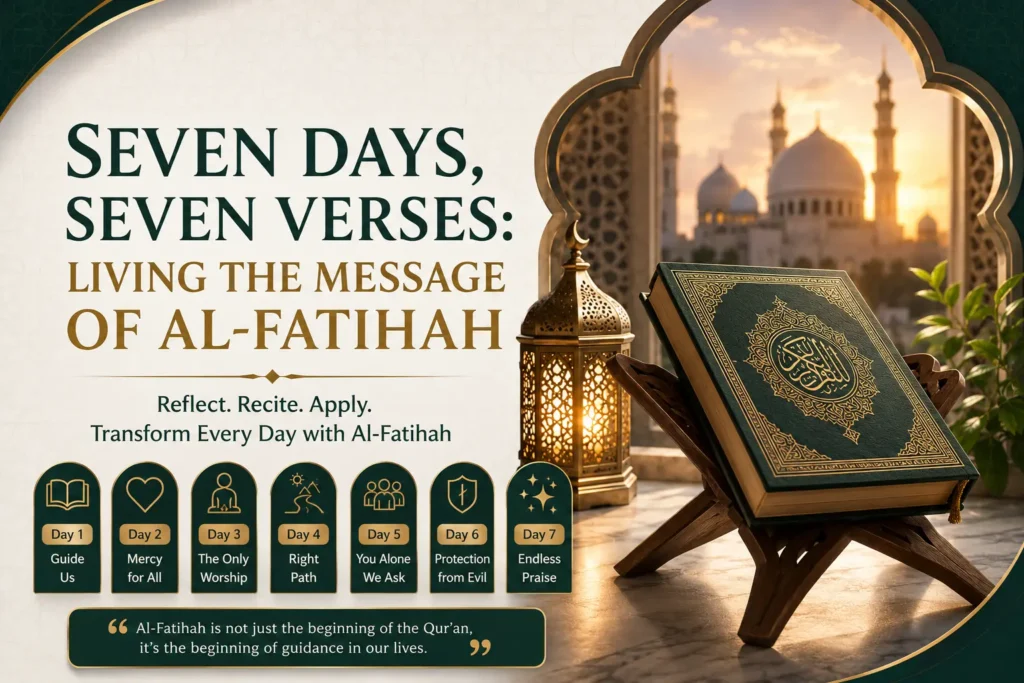
Seven Days, Seven Verses: Living the Message of Al-Fatihah
Surah Al-Fatihah is one of the most familiar chapters of the Quran for Muslims. It is recited in every unit of the daily prayer, repeated countless times throughout a person’s life. Yet familiarity can sometimes make us overlook its depth. We know the words. We may know their translation. But do we pause to think about what they are asking us to believe, feel and practice?
Al-Fatihah is more than a surah we recite during salah. It is a conversation with Allah, a declaration of faith, an expression of gratitude. A prayer for guidance, and a reminder of the path we want to follow.
A simple way to explore its message is to spend seven days reflecting on its seven verses. Instead of trying to understand everything at once, take one verse each day and ask a practical question:
“How can I live this verse today?”
This seven-day approach can help turn familiar words into meaningful daily reminders.
Day 1: “In the Name of Allah”
Al-Fatihah begins with:
“Bismillahir-Rahmanir-Raheem”
In the name of Allah, the Most Compassionate, the Most Merciful.
Beginning with Allah’s name changes the way we approach an action. It reminds us that our lives are not separate from our relationship with our Creator. Before starting work, studying, preparing a meal, traveling or beginning an important task, saying Bismillah can become a moment of awareness. It is not simply a phrase to repeat quickly. It can remind us to ask whether what we are doing is good and whether we are approaching it with the right intention.
Today’s reflection
Before beginning something important today, pause for a moment and remember Allah.
Ask yourself:
“Am I starting this with a genuine and good intention?”
For someone balancing work and family in Pakistan, or managing a busy professional or student life in the United States. This small pause can bring spirituality into ordinary moments.
Day 2: Remembering Allah as the Lord of All Worlds
The second verse says:
“Alhamdu lillahi Rabbil-‘alamin”
All glory belongs to Allah, the Lord of the world.
The word Alhamdulillah carries a powerful message of gratitude and praise.
Life naturally draws our attention toward what is missing. We think about financial pressure, work problems, family concerns, health, education or uncertainty about the future. This verse redirects our attention toward Allah and His countless blessings. Being grateful does not entail denying the existence of challenges. It means recognizing that difficulties are not the whole story.
Today’s reflection
Take a few minutes and identify three blessings in your life.
They could be simple:
- A supportive family member
- A safe place to live
- Food on the table
- The ability to pray
- A new opportunity
- Good health
- A second chance after making a mistake
Say Alhamdulillah and genuinely reflect on what you have.
Day 3: Allah’s Mercy
The third verse again reminds us:
“Ar-Rahmanir-Raheem”
The Most Compassionate, the Most Merciful.
Allah’s mercy is central to our relationship with Him.
Sometimes people become discouraged because of their mistakes. A person may think, “I have made too many mistakes,” or “I am not good enough to return to Allah.” The message of Al-Fatihah gives us another perspective. We are repeatedly reminded of Allah’s mercy.
This does not mean that wrongdoing should be ignored. Rather, it encourages sincere repentance and hope. For Muslims living anywhere from Lahore and Karachi to New York and Chicago. The reminder is universal: never allow your mistakes to convince you that returning to Allah is pointless.
Today’s reflection
Think about one mistake or weakness that has been bothering you. Instead of remaining trapped in guilt, turn toward Allah with sincere repentance and ask for His mercy.
Day 4: The Day of Judgment
The fourth verse says:
“Maliki Yawmid-Deen”
Master of the Day of Judgment.
This verse reminds us that our actions have consequences and that worldly life is not the end of our story. Modern life can make temporary things feel permanent. Money, career success, social status, popularity, possessions and achievements can become our main focus. Remembering the Day of Judgment puts these things into perspective.
It encourages us to ask not only:
“Will this benefit me today?”
but also:
“Is this something I will be pleased to have done when I stand before Allah?”
Today’s reflection
Before making one important decision today, consider its long-term spiritual consequences. Would the choice reflect honesty, responsibility, kindness, and obedience to Allah?
Day 5: Worship and Dependence
The fifth verse contains one of the most powerful statements in Al-Fatihah:
“Iyyaka na’budu wa iyyaka nasta’een”
We worship you alone, and we pray to you alone for assistance.
This verse connects two essential parts of faith: worship and dependence on Allah. We are surrounded by people and resources that can help us. We seek advice from family, teachers, professionals, friends and communities. Islam does not require us to abandon those means.
But our ultimate dependence remains upon Allah. This perspective can be especially meaningful during difficult periods. When a student is worried about education, a parent is concerned about their children. A business owner faces financial pressure or someone feels uncertain about the future. This verse provides a foundation: worship Allah and seek his help.
Today’s reflection
When you face a problem today, take practical steps to solve it but also turn to Allah in dua. Let effort and reliance work together.
Day 6: Asking for the Straight Path
The sixth verse is a direct prayer:
“Ihdinas-siratal-mustaqeem”
Guide us to the straight path.
Notice that we are taught to ask Allah for guidance repeatedly. Guidance is not something we need only once. Every day brings decisions, temptations, relationships, opportunities and challenges. We need guidance when choosing friends, earning money, using social media, raising children, studying, working and dealing with disagreements. The prayer for guidance teaches humility. Instead of assuming that we always know what is best. We acknowledge our need for Allah’s direction.
Today’s reflection
Decide which aspect of your life requires direction. It could be a career decision, relationship, financial matter, habit, or personal struggle. Ask Allah sincerely to guide you toward what is right.
Day 7: The Path We Want to Follow
The final verses describe the path we ask Allah to guide us toward:
“Those who have gone wrong or those who have earned your wrath are not benefited by your route.”
The ending of Al-Fatihah reminds us that guidance is connected to the choices we make. We do not simply ask to know the right path. We ask to remain on it. That requires learning, humility, consistent worship, good character, and a willingness to correct ourselves. The final lesson of our seven-day journey is therefore about direction.
Where are your daily choices taking you?
Are your habits bringing you closer to Allah or gradually distracting you from Him?
Today’s reflection
Look at your daily routine honestly. Choose one habit that brings you closer to Allah and strengthen it. Then identify one habit that repeatedly pulls you away from your values and begin working on changing it.
How to Continue After the Seven Days
The purpose of this seven-day exercise is not to finish Al-Fatihah and move on. The goal is to begin seeing the surah differently. When you recite Al-Fatihah during salah, remember its progression:
Praise → Mercy → Accountability → Worship → Dependence → Guidance → The Right Path
These seven verses form a powerful spiritual journey. You begin by recognizing Allah’s greatness and mercy. You acknowledge the reality of accountability. You declare your worship and dependence upon Him. Then you ask for guidance and commit yourself to the path of those who received His blessings.
That is why Al-Fatihah can remain relevant throughout every stage of life. Whether you are a university student in Pakistan, a professional living in the United States, a parent raising children, or someone simply trying to become closer to Allah, its message speaks directly to everyday life.
Frequently Asked Questions
What is Surah Al-Fatihah’s primary message?
The main message of Al-Fatihah is recognizing Allah, praising him, acknowledging his mercy and authority. Worshipping him, seeking his help and asking for guidance to the straight path.
Why is Al-Fatihah called the opening chapter of the Quran?
Al-Fatihah is the first chapter of the Quran and serves as an introduction to many central themes of the Quran, including worship, Allah’s mercy, accountability, guidance and the righteous path.
How can I understand Al-Fatihah better?
Read its translation, study reliable explanations from qualified scholars, reflect on each verse, and consider how its message applies to your everyday decisions and worship.
Can I reflect on one verse of Al-Fatihah each day?
Yes. Taking one verse at a time can be a simple way to slow down and think about the meaning rather than reciting the words without reflection.
What does “Iyyaka na’budu wa iyyaka nasta’een” mean?
It means, “You alone we worship, and You alone we ask for help.” It expresses devotion to Allah and recognition that ultimate help comes from Him.
Why do Muslims recite Al-Fatihah in Salah?
Al-Fatihah has a central role in the Muslim prayer, and its recitation connects worshippers with its message of praise, worship, dependence upon Allah, and the request for guidance.
What does Al-Fatihah teach about guidance?
Al-Fatihah teaches Muslims to continually ask Allah for guidance toward the straight path and to seek to follow the path of those who received His blessings.